Who Would The World Be Better Off Without?

Don’t say it out loud. Just think it.
Somebody came to mind. Was it a Murderer? A molester? Drug dealers? Drug addicts? Billionaires? Nazis? Terrorists? MLM distributors? Telemarketers? That asshole who cut you off the other day?
Everybody who has ever claimed human life is sacred has, somewhere in the back of their mind, reserved an asterisk. We all have at least one.
As such, the sanctity of human life has an asterisk for you as well.
Don’t defend the choice.
Don’t explain it.
Just hold it in your mind for a bit.
That asterisk is not a confession of bad character. It’s the raw material this essay is actually interested in, because before any of us can discuss healthcare, punishment, or basic human rights, we have to know what people mean when they say human life is sacred in the first place.
The question isn’t whether you had someone in mind- you and I both know you did.
The question is what your asterisk actually permits.
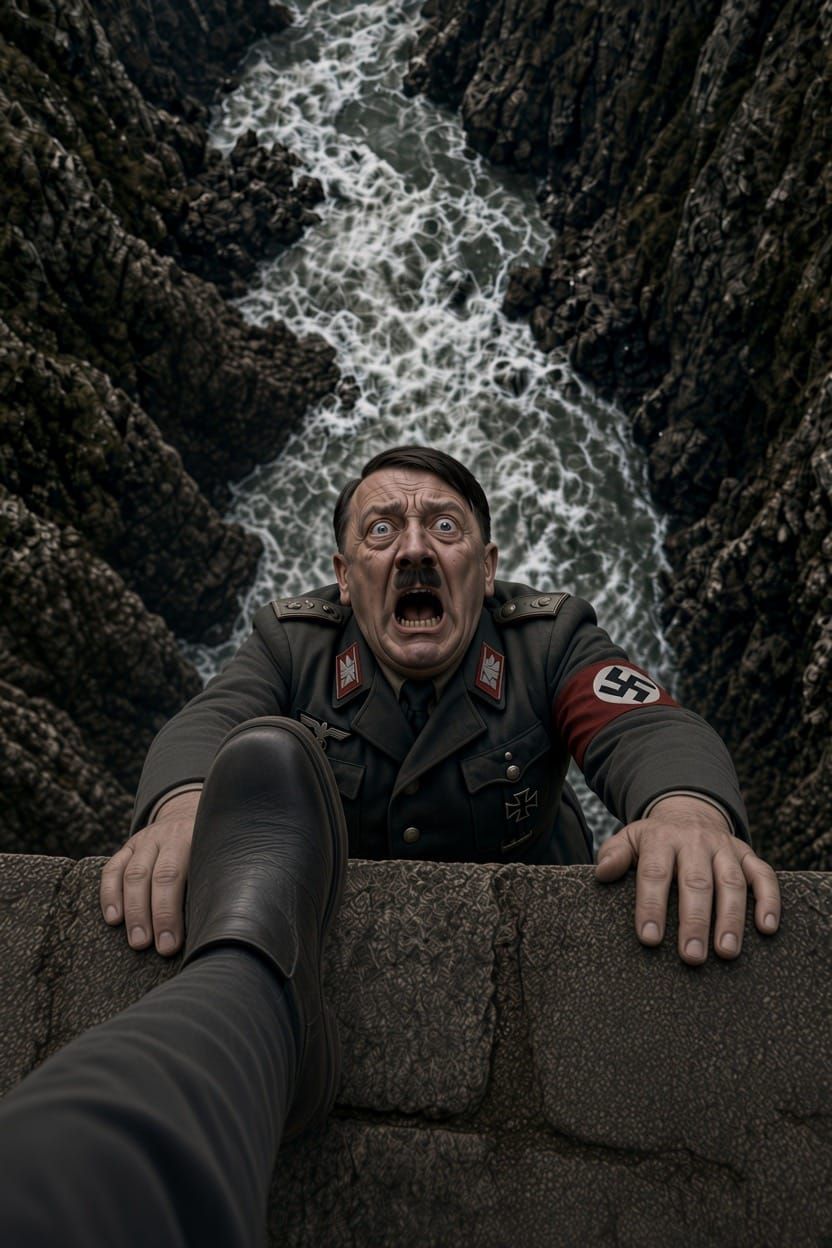
Thinking the world would be better without someone isn’t the same as wanting to kill them. Wanting them gone isn’t the same as believing they’ve forfeited their right to exist. Take the person or type of person you imagined, and put them on a bridge, hanging by their fingers. There you are, standing above them- your foot hovering over their fingers.
Would you step on their hand? Would you reach down and pull them up yourself, even at some cost to you? Would you just walk away? Would you expect an institution built for exactly this to do it instead… and would you help pay for that institution to exist?
All different questions, and underneath them lurk four different propositions: I wish this person didn’t exist. I would cause this person’s death. I would permit this person’s preventable death. I reject any collective obligation to prevent this person’s death. These all overlap, but they aren’t the same claim, and a society can arrive at the third by way of a thousand individually reasonable refusals of the fourth, without anyone ever having advocated the second.
A New Social Contract
I am not asking whether the person or people you have in mind are good or bad. Their virtue is no longer the relevant variable- neither is whether you like them, whether they’ve been productive, nor even whether they deserve anyone’s approval. I ask instead what being human entitles a person, any person, to.
Call it a social floor. I’m not talking about equality or the right to pursue happiness. This certainly isn’t about protection from every consequence life can hand out. A social floor is the minimum threshold beneath which a society refuses to let a human being fall when preventing the fall is reasonably within its power.
This essay is introducing you to what I call the Luciferian Social Contract.
The contract consists of two parts: civilianship and citizenship.
Civilianship belongs to everyone simply because they are human. It establishes the basic rights no person has to earn and no person can be denied.
Citizenship is different. It is participation in the authority society exercises over everyone else, and under this contract, that authority is earned through meaningful service to the society in which it is exercised.
We’ll start with civilianship.
This is the social floor it proposes:
Food.
Water.
Shelter.
Dignity.
Reasonable medical care.
Under this contract, all human beings would be guaranteed these things, no matter what.
None of that is difficult to apply to a person you favor. No decent human being would deny food to a hungry child or water to a dehydrated accident victim. The test isn’t there. The test is the murderer getting food, the drug dealer getting shelter, the terrorist getting medical care, and the telemarketer keeping their dignity- not because they’re good, not because they earned it, not because their victims stop mattering, but because the floor is attached to their humanity rather than their virtue.
Simply put, a basic human right is something you don’t lose by becoming someone I hate.
If good behavior is a prerequisite, it’s a reward. If my approval is a prerequisite, it’s permission. Rights are easy to affirm for people who never need them protected. The real test shows up the moment you want to apply them to someone you’d rather not.
None of this abolishes consequence. A murderer can still be imprisoned. A dangerous person can still be separated from potential victims. Someone who causes damage can still owe restitution. What none of it requires is starvation, exposure, or denial of reasonable medical care as an additional punishment once someone has become sufficiently condemned. The floor wouldn’t be there because everyone deserves everything. The floor would exist because we collectively decided what nobody deserves.
Consequence protects, deters, contains, and rehabilitates where it can. Punishment for its own sake is just distributed suffering wearing righteous indignation as a justification, and the more hated the person is, the more that distinction matters, not less.
What Might This Cost?
Declaring these things human rights doesn’t make them free. Food has to be grown and moved. Water needs treatment plants to produce it and pipes to deliver it. Shelter needs land, materials, and lots of labor. Medical care needs doctors, machines, and lots of medicine.
The floor costs something…
But what? Money?
Have you ever seen an apple tree with a coin slot?
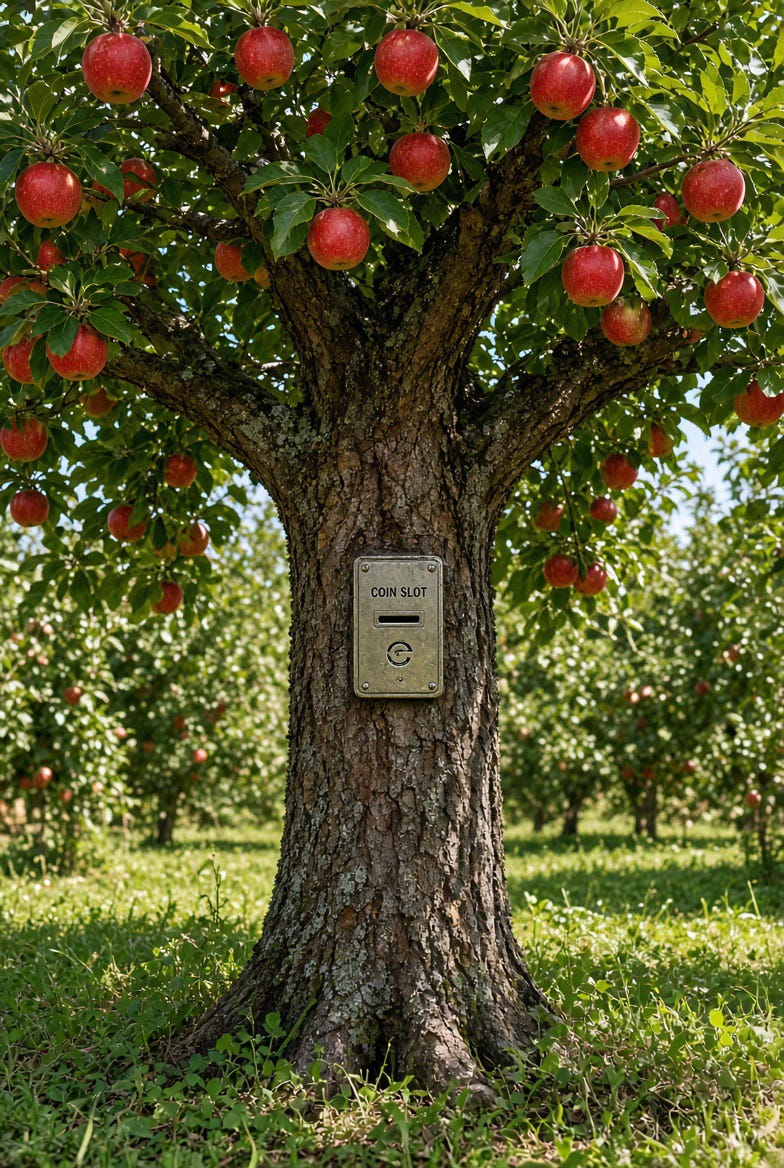
Money doesn’t produce any of those things. People do- people manipulating resources. Money is a social tool we’ve invented to organize people’s access to resources. I’ve explained the monetary angle elsewhere, in The Government Doesn’t Need Your Money. What matters here is that money is not a resource. It is definitely not scarce, because it is fiction, and we humans have a never ending supply of fiction.
Real scarcity deserves respect. Not enough food is a food problem. Not enough houses is a housing problem. Not enough doctors, beds, medicine, or hours in the day is a capacity problem. Calling access to any of these a right doesn’t make any of that math disappear. What it does do is force us to re-evaluate the value of a human being. The resources are there. What’s often missing is a person’s permission to touch them.
The Luciferian Social Contract doesn’t promise infinite resources. It doesn’t need to. It promises something smaller and harder to argue with: maintaining the floor gets priority in how the resources we do have are allocated.
What Nobody Chose
There is another way to end up below the floor without anyone deciding you belong there. Nobody has to actively wish someone dead for a society to tolerate their preventable death. It can happen through a stack of individually defensible decisions: this is a liberty issue, that’s a property issue, this person should have planned better, that person should have paid in. Each decision can sound perfectly reasonable on its own while their combined effect leaves someone hungry, homeless, untreated, or dead.
Nobody has to vote for that outcome. Nobody even has to want it.
That is part of what the floor is designed to prevent. Certain outcomes come off the table before the bargaining even begins. We can argue about taxes, property, programs, incentives, responsibility, and everything above the floor without repeatedly putting the floor itself up for a vote.
Will some people take advantage of that? Of course. Any system built for human beings will be taken advantage of by some of those human beings. There no way to completely eliminate fraud and exploitation. What this social contract asks us to do is tolerate this aspect of human nature so that the even darker aspects can be stripped of their ability to cause extreme, unnecessary suffering.
The goal isn’t a system nobody can cheat.
It’s a system that can survive being cheated without abandoning the people it exists to protect.
Who’s In Charge?
So far, we’ve been talking about civilianship: the rights you have simply because you are human. Citizenship is the other half of the contract. It concerns something fundamentally different- not what society is or is not permitted to do to you, but the authority you are permitted to exercise over everyone else.
Under the Luciferian Social Contract, citizenship is earned through meaningful service to the commons. Military service can qualify, but so can caregiving, education, emergency response, infrastructure work, environmental stewardship, public service, and other work that measurably contributes to the society whose authority a citizen participates in exercising. No single institution gets to own the path to citizenship, and no particular form of service makes one citizen more of a citizen than another.
The path to citizenship also has to be genuinely available to everybody. A system that technically allows anyone to serve but requires money, physical ability, geographic access, or freedom from caregiving responsibilities that many people simply don’t have hasn’t created an equal path to citizenship. It’s created a permanent underclass.
Different abilities and circumstances require different ways to contribute, and service substantial enough to demand a person’s time and labor can’t become a privilege reserved for people wealthy enough to provide it for free. This is why all forms of public service require just compensation.
Citizenship, in return, carries civic privileges such as voting, eligibility for certain public offices, and other incentives. Because that authority is tied to social responsibility, citizenship need not be a permanent achievement obtained once and possessed forever; maintaining it may require continued service to the commons over time. In fact, citizenship can be suspended under certain circumstances, but there must always be a path to reentry.
Survival is not earned, but civic authority is.
None of this makes a citizen more human than a civilian. Someone who never seeks citizenship, never qualifies for it, or chooses not to maintain it still keeps every part of the social floor. Food, water, shelter, dignity, and reasonable medical care don’t become rewards for political participation. You do not earn your humanity by serving society. You were born with it. You earn authority within society by demonstrating responsibility toward it.
Earning authority, however, does not mean owning it. Citizenship can give someone a legitimate voice in the decisions a society makes without giving them the authority to decide whose humanity counts. The distinction becomes especially important when the resources needed to maintain the floor are genuinely scarce. After all, somebody still has to decide where the floor ends when there isn’t enough to go around.
Scarcity forces a choice about allocation, but it doesn’t require anyone to decide that a specific human being doesn’t qualify for the floor. Those often get treated as the same problem, but they aren’t. The former is arithmetic while the latter is a verdict…
And whoever ends up making that verdict- whether it be a doctor, an insurer, a bureaucrat, a legislator, or even your grandma- is just another person carrying the same asterisk you carried in to this exploration. There aren’t necessarily any villains in this. There are people, making tough choices. There’s always someone just as capable as you are of deciding, possibly in a moment of scarcity or fear or disgust, that a particular person has somehow forfeited their claim on being human.
I don’t trust anyone with that authority.
It’s not because people are monsters.
It’s because people are people.
Most make the mistake of designing the system for angels. The Luciferian Social Contract takes a different approach. It assumes selfishness, tribalism, resentment, the occasional bit of outright cruelty, and builds something that keeps working anyway- perhaps even better.
We can’t expect a civilization full of people who love each other.
We, therefore, need a social contract that holds up when they don’t.
The List Goes Both Ways
As we’ve established, you have a list. I have a list. Everybody has a list of people they can do without. Now for the uncomfortable truth:
You are on somebody’s list.
So am I.
So is everybody.
It’s not necessarily for anything you did. Maybe it’s for what you believe, who you vote for, who you associate with, or even what you look like. Somebody, somewhere, has decided the world would tick along just fine without you in it, and they’re just as convinced of it as you are about your guy dangling off the bridge.
I’m not telling you this so you’ll feel bad. I am revealing to you the primary reason to want this contract. The Luciferian Social Contract is, at its core, a mutual ceasefire at the level of personhood. Under it, no one gets to decide that your humanity is negotiable. In exchange, neither can you decide that about anyone else.
We don’t have to like each other for that to hold. We don’t have to agree about who’s admirable or who’s a waste of skin. We merely come to agree that none of us gets to decide who does not qualify as worthy of existing.
By agreeing to this contract, you’re not just protecting others.
You’re protecting the version of you that ends up on somebody else’s list.
Back to the Bridge
So there you are, with the person you decided shouldn’t exist dangling from a bridge right in front of you. No one is asking you to forgive them. You don’t have to accept them. You don’t even have to decide you were wrong to put them on that list in the first place.
Just look at them again- hanging there, exhausted, terrified, and entirely dependent on what you do next- and ask the only question that actually matters: does your judgment about them give you the authority to decide their humanity doesn’t count?
No. It never did. Not yours, not mine, not anyone’s.
Just as no one’s judgement of you should put you in their position.
Thought isn’t authority. Disgust isn’t authority. Hatred, no matter how earned it feels, isn’t authority either.
So keep your answer.
Keep your list.
Keep your justifications for all of it.
All this contract really asks of you in the moment…
Is to keep your foot off their fingers.