The Government Doesn't Need Your Money


It makes its own. It only claws some back to manage value… So let’s change what it claws at.
You were taught a story about money, and you were taught it the way you were taught about gravity- as if it were a matter of physics instead of mere policy. The government is like a household, the story goes. It earns before it spends. It taxes you first, fills the jar, then doles the contents of the jar back out in the form of roads and school lunches and the occasional fighter jet. Run the jar empty and the government borrows, hat in hand, from people who have cash on hand to invest.
Deficits are debt.
Debt is danger.
Someday, someone warns, the bill comes due.
None of that is how the system actually works.
That version is not “incomplete.” Not “oversimplified for the layperson.” It is simply wrong- the wrong operating system entirely, taught to a population that will spend its whole life inside an economy built on different rules than the ones it was handed. The household story isn’t a simplification of the real mechanism. It is a different mechanism altogether, borrowed from an era when currency was gold-backed and governments genuinely could run out.
That era ended.
The story didn’t.
For clarity, what we are discussing here is the Federal Government, or any government which issues its own currency. State and local governments still must follow the jar scenario, but at the Federal level, the 1971 elimination of the gold standard was the final chapter of the jar story.
So why does that story linger in an economy it no longer describes? It survives because it’s useful- not to you, to the people who benefit when your imagination is limited to “can we afford it.” A population convinced the jar is empty will accept almost any scarcity you hand them. Hospital beds. Clean water. A functioning bridge. All the while excess funds never cease to build bigger yachts.
“Scarcity is not a law; it is a leash. It is the sacred fiction of empire, draped in numbers and recited as necessity. On the surface it reads like prudence; underneath it is choreography- obedience by design, not accuracy.”
Doctrine of Lucifer, Chapter 9.2
What Actually Happens When Congress Spends
Strip the mythology of “I’m Just a Bill” and look at the sequence. Congress authorizes a program. The Treasury instructs accounts to be credited. The money exists now, where it did not exist before. It was not pulled from a vault, nor fished out of your withholdings. It was conjured by the same authority that conjures the currency’s value in the first place. Spending happens first. Only afterward does the question of removal of funds from the system arise, and said removal happens through taxing and borrowing…
After its creation.
This is not a radical theory smuggled in from some fringe corner of economics. It is Modern Monetary Theory’s operational description, and it matches, sentence for sentence, what central banks already do and already say. The Federal Reserve targets 2% inflation as the guarded ideal of perfect stability, but why? Why that number? And why have deliberate inflation at all? An economist might tell you that devaluation of currency ensures investment of capital over hoarding, and it does, but it just so happens that Modern Monetary Theory sets the target at 2%. The Fed’s policy concedes the mechanics even while the public story keeps insisting on the jar.
MMT is NOT just a theory.
It is fully operational.
The Government does not need your money.
It makes its own.
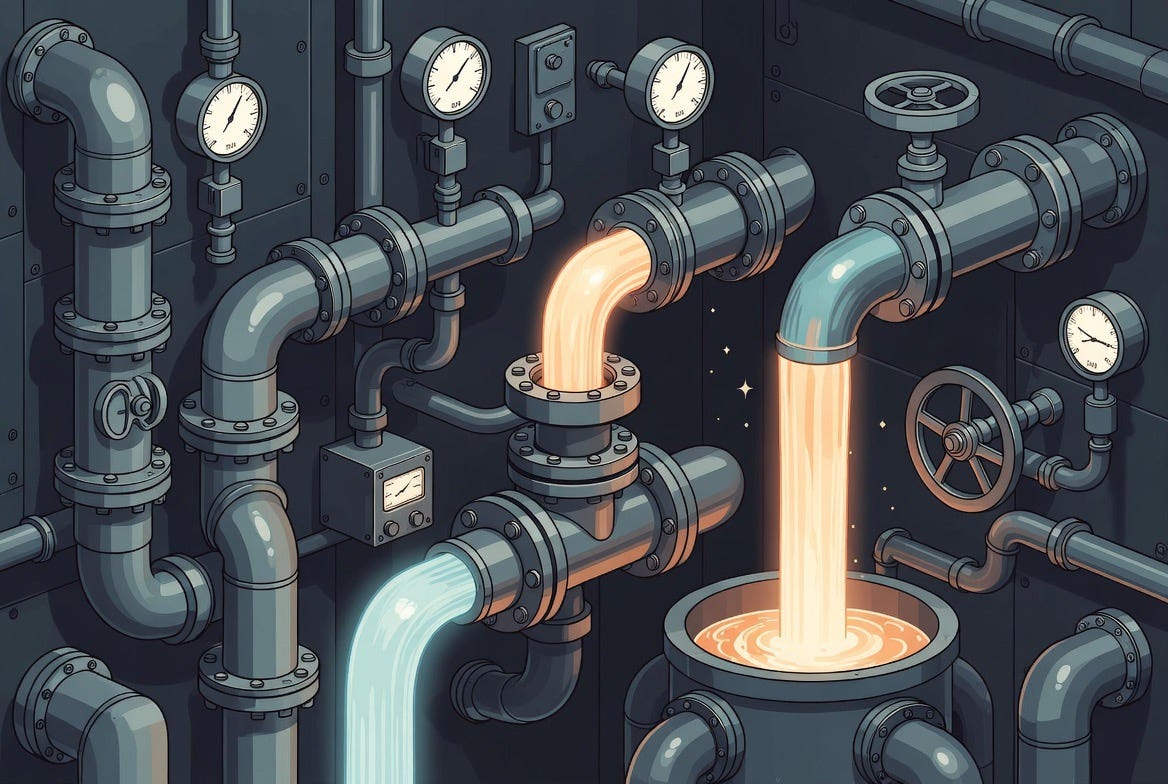
The tax bill is not a receipt. It is a valve.
“Taxation stops masquerading as morality and starts operating as filtration. Ethics arrive by filtration, not by faith. If the issuer is never short of its own tokens, taxes are not the fuel that powers spending; they are the drains that keep the fire from running wild.”
Doctrine of Lucifer, Chapter 9.1
The trained reflex is to hear “the government can just print money” and flinch toward Zimbabwe, toward Weimar, toward every cautionary tale stacked up to keep the conversation from going further. Those flinches aren’t wrong to have. They’re wrong to stop at. The constraint was never digits in an account. The constraint is capacity- the workers, the materials, the skilled hands, the ecological room the economy actually has to build in.
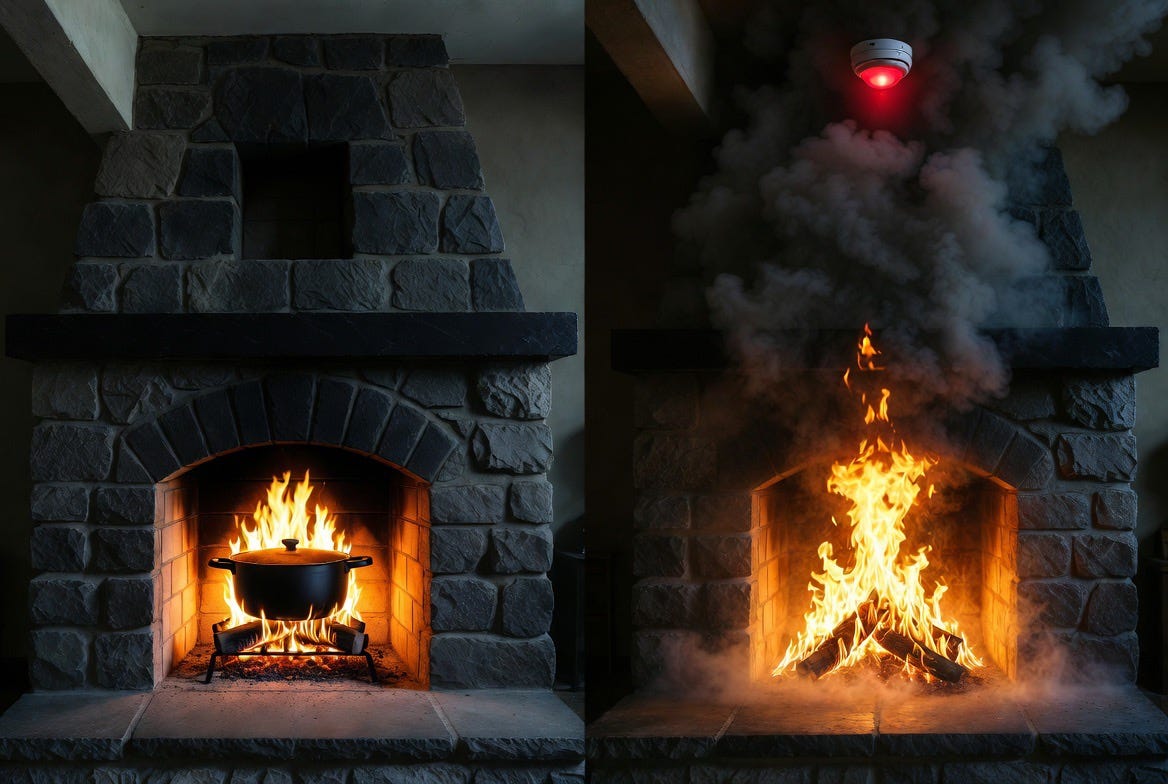
Currency is not a physical, tangible resource. Currency is energy. Currency is fire. Fire needs fuel, and the fuel is what a country can actually mine, grow, staff, and ship. Feed a fire past what the fuel supply can sustain and it doesn’t grow stronger.
It jumps the hearth.
Price hikes are the smoke alarm going off as the room overheats.
Keep the fire inside what the fuel can support and it does what fire in a hearth has always done- cooks the meal, warms the house, keeps the dark outside. The danger was never the flame. It’s building a fire bigger than the wood pile.
The Bond Is Not a Loan. It’s a Drain.
Here is where the household story does its most convincing work, because government bonds look like borrowing. The government sells a bond, an investor hands over dollars, and it reads exactly like a loan- proof, surely, that the government needed the money and didn’t have it.
Read the sequence again. The spending already happened. The dollars already exist in the economy, already sitting in bank reserves, already capable of chasing goods and driving prices upward if left alone. The bond arrives after, not before, as an offer to investors: park your excess funds somewhere they can’t move prices, and we’ll pay you interest for holding still.
A bond is not a request for money the government lacks.
It is an invitation to freeze money the government already spent, so it stops adding heat to a room that’s already warm enough.
The purpose of bonds is to regulate inflation, not to fund the Government.
Bonds are not evidence of dependence.
They are a drain valve wearing a borrowing costume.
That distinction is not decorative. It changes what bonds are for. If the goal is temperature control- pulling excess currency out of active circulation before it overheats prices- then bonds are one valve among many possible valves, not the load-bearing wall of the whole operation. The reason bonds dominate isn’t that they’re the only tool. It’s that they’re the tool that keeps the household jar story alive, the one that lets a politician say “we had to borrow” instead of “we chose to cool the room this way.” A different valve, equally functional and less mythologized, would do the same job without feeding the same lie.
Better Drains Exist.
Consider what this means for the deletion side of the ledger- the removal, the cooling, the part of the cycle the jar story pretends doesn’t exist because it thinks the jar was never full to begin with.
If bonds are just one method of pulling excess currency back out of circulation, they certainly are not the best method. They’re just the incumbent. A bond sterilizes money broadly, indiscriminately, wherever an investor happens to be sitting on cash they want parked. It does nothing to ask where the heat actually is.
Compare that to targeted deletion- taxation aimed at the exact zip codes where speculation is cooking the housing stock, at the exact sectors where monopoly rents are choking competitors, at the exact transactions where churn generates fees without generating value. One tool cools the whole room evenly and calls it done. The other reads the thermostat in every room and adjusts accordingly.
This is the Architecture of Sustainable Corruption applied to modern monetary design, and the name is doing real work, not just shock value. The Architecture does not pretend appetite can be legislated out of existence- that status-seeking, comfort-seeking, advantage-seeking humans will simply stop wanting what they want because a law told them to.
Appetite is a constant.
The only design question is whether it moves through visible channels that can be priced and audited, or underground ones that can’t.
“Surface what people will predictably chase- status, influence, comfort- then route it through visible channels with friction attached. Make coherence the highest-paying game in town. Make manipulation expensive and boring. Make service cheap and visible. The future doesn’t eliminate appetite. It rechannels it into drains everyone can audit.”
Doctrine of Lucifer, Chapter 8.7
Applied to currency: surface what people will chase. Speculative gain. Rent extraction. Regulatory capture. Black market items. Legalize and regulate these industries so that the currency can be routed through drains built to catch exactly that heat- progressive taxation on concentrated wealth, transaction taxes on high-frequency churn, sin taxes, carbon pricing at the point of extraction, monopoly enforcement that prices the cost of consolidation before it calcifies.
None of this moralizes.
None of it pretends the appetite is evil.
It prices the externality and lets the ledger tell the truth that the sermon couldn’t.
Ease where the opposite is true. Wages. Basic goods. Care work. Small-firm formation. The places where friction doesn’t cool anything- it just punishes contribution for existing.
“What we tax, we chill.
What we subsidize, we irrigate.
The honest principle is simple: do not drain the well you drink from.”
Doctrine of Lucifer, Chapter 9.1
“Money is issued. Mercy is design.”
The direction of currency comes from decisions made by people, and affects everything the currency touches, including who eats and who doesn’t. Somewhere a room full of people decided a hospital wing was affordable and a housing subsidy wasn’t. Nobody discovered that distinction in a spreadsheet. They wrote it. The spreadsheet just recorded the choice after the fact and let it wear the costume of inevitability.
This is what the jar story was built to hide. Present spending as a discovery- we found the money, we didn’t find the money- and the choice disappears into the discovery. Nobody has to own the decision to fund one thing and starve another.
The household story was never really about economics. It was about obedience- a leash dressed up as arithmetic, sold to people who were never taught to check the math. Keep the leash convincing enough and the people wearing it will police each other for asking whether it’s real.
Scarcity that is real deserves respect: soil, water, skilled hands, the hours in a day. These have edges. Push past them and something actually breaks- the aquifer drops, the air chokes, the trades run short. One day still only holds twenty-four hours no matter how badly the balance sheet may need thirty.
Scarcity that is manufactured deserves the opposite. It has no edge to hit, only a story insisting one exists. A hospital doesn’t run out of dollars the way a well runs out of water. It runs out of a decision to spend.
Watch how fast the manufactured scarcity dissolves the moment the room decides the spending is urgent instead of optional. The same government that couldn’t find money for water infrastructure finds it for a war in a weekend. The jar didn’t refill. The story just stopped being useful to the people telling it.
You do not negotiate with a fiction.
You expose it.
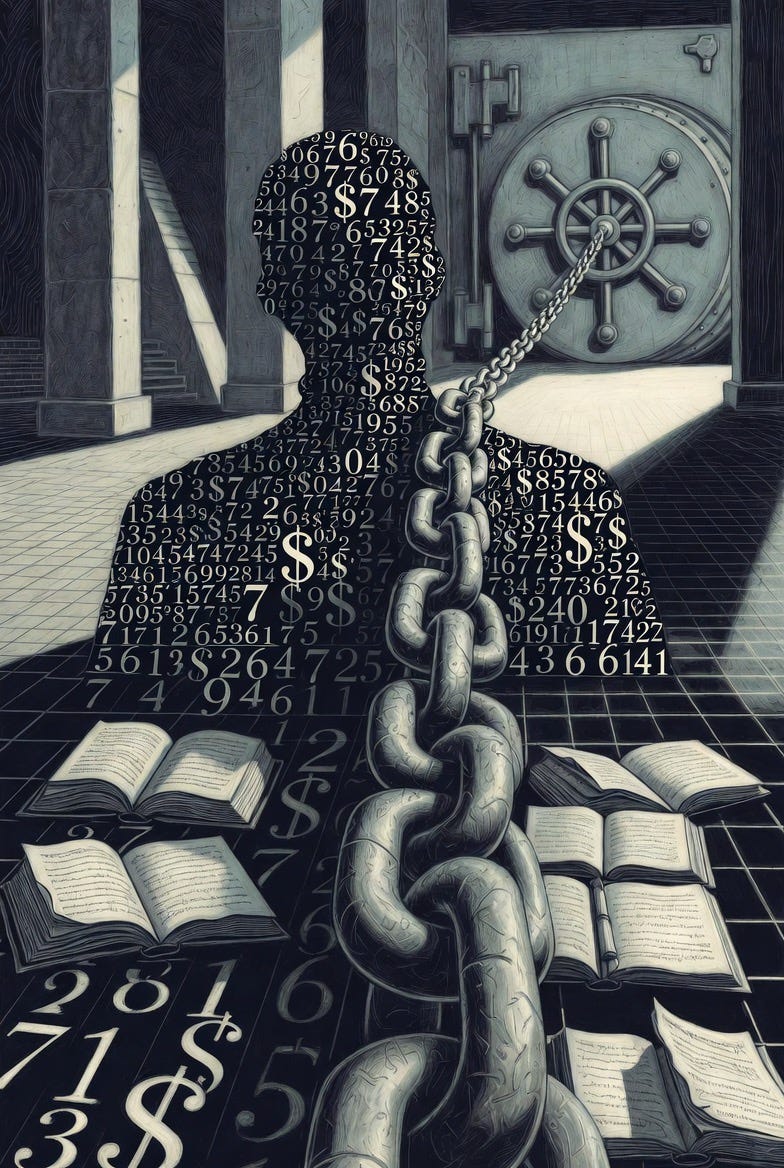
There is no vault.
Fiat currency is not physical or tangible, like gold, or silver. It is a social contract. It is an agreement that numbers on a ledger have value. There is nothing to put in a jar, nor to take out of it. The vault was never full, was never emptied, and was never refilled by your April taxes before Congress could spend a dime. The Government creates the currency by acts of Congress. Bonds and taxes remove currency the government already spent, and they do it bluntly, when finer tools are available and simply underused. Better filtration is a design choice, not a discovery waiting on some future economist. The tools exist now- targeted deletion, transparent drains, published temperature readings instead of rumor-driven panic about a debt clock counting down toward nothing in particular.
Most of the public argument about government spending is happening inside a model that was retired the day the gold standard ended. Correct the model and the fight changes shape. “Can we afford it” stops being a serious question, because it was never really asking about capacity.
It was asking whether you’d stay quiet.