The Apes That Never Grew Up

What kind of animals built our civilization?
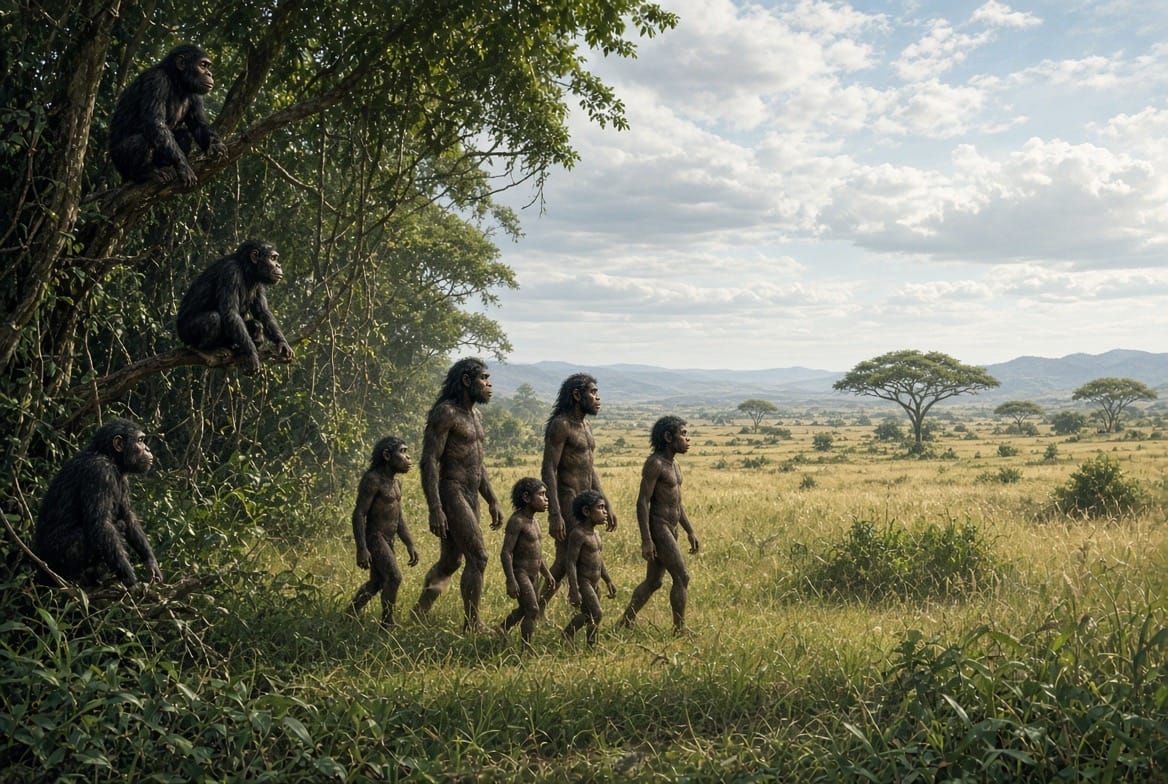
The trees end, and they keep walking anyway. Out here there is no cover- just grass and sky. They move wrong for this. Bodies too soft, faces too young, clinging infants that should have let go months ago. Nothing about them looks built for open ground. Yet here they are, upright, exposed, watching each other more than they watch the horizon- as if the other apes beside them are the only defense they have.
Because they are.
No claws; only fingernails. No speed. No armor. Only a habit of copying what works, correcting what doesn’t, and passing it sideways before the ground finds a way to kill them for the mistake. It shouldn’t be enough, and for a long time, it barely is. Something is different about this group, though. They are still finishing- their bodies, brains, their childhood- long after the other apes their age have already stopped. Whatever that unfinished animal becomes next, it will not stay on this plain.
Civilization did not manufacture the traits that made civilization possible. Cities, agriculture, writing, government, theology, and law all arrived extraordinarily late in the life of this species. Something stranger came first.
We took an exceptionally long time to mature. We depended heavily on other humans, long past the point most animals stop needing anyone. We learned compulsively, played long after playing stopped being useful, cooperated intensely while remaining capable of extraordinary violence, and survived in radically different environments without ever evolving a separate body for each one.
It’s not that humans became intelligent and therefore invented civilization. It is closer to this: humans became unusually dependent on learning from other humans, that dependence produced cumulative culture, and cumulative culture slowly became an adaptive system in its own right.
That system, then, required humans to become even more dependent on learning from other humans.
Delay buys plasticity.
A newborn human is spectacularly incapable. It cannot walk. It cannot feed itself. It cannot even communicate its needs with any sense of precision. Every part of its survival depends on prolonged investment from other humans, extended far past the point most mammals require. Brain development continues for years. Childhood stretches on long after basic physical dependence would predict it should end. Adolescence adds a second prolonged stage on top of the first, and meaningful learning continues well into adulthood.
The animal that would eventually control much of the planet begins life unusually unfinished, and stays unfinished for an unusually long time.
From an evolutionary perspective, this looks like an expensive arrangement. A helpless infant requires years of food, protection, attention, and teaching before it can contribute much to its own survival. It also ties the survival of the child to the survival and cooperation of other humans. We retain an unusual degree of behavioral plasticity well into adulthood. We keep experimenting, imitating, playing, modifying social roles, adopting new techniques, and acquiring new symbolic systems…
But why?
The phrase “the apes that never grew up” works on several levels at once. Physically, some human traits resemble juvenile ape characteristics retained from earlier developmental stages. Developmentally, maturation itself is stretched far beyond what the hairy apes require. Behaviorally, exploratory learning stays important across an entire lifespan. Socially, adults never stop depending on skills and information they acquired from someone else.
Humans are not literally juvenile apes, of course. It’s just that human evolution, as it branched off from the evolution of other primates, appears to have retained and extended several traits associated with developmental flexibility, and that flexibility may matter more to the story than any single anatomical trait attached to it.
The same prolonged development that creates the liability also creates the opportunity. A human child has an unusually long period in which its brain and behavior can be shaped by the particular world into which it is born. The animal arrives unfinished, which means much of what finishes it can come from somewhere other than the genome.
Being born unfinished became an advantage precisely because the environment could finish the animal differently depending on where it landed. A human born in the Arctic does not need an Arctic genome. A human born in a rainforest does not need a rainforest genome. Each inherits roughly the same body and learns a completely different way to operate it.
Domestication without a domesticator
An intensely cooperative animal pays a real cost for uncontrolled reactive aggression- group life demands tolerance, child-rearing demands patience, and teaching demands enough trust and proximity for imitation to work at all. Someone who attacks whenever frustrated is dangerous not just to enemies, but to everyone trying to live beside them.
No breeding program is required for this. Mate choice, alliance formation, punishment, exclusion, reputation, and exile all impose selective pressure on their own. Selection against reactive aggression would not necessarily produce a peaceful species, but it would lead to tribalism, as responsive aggression could be coordinated. Less likely to punch the person beside you is not the same thing as less capable of killing the people over the hill. Cooperation can scale violence just as easily as it can dampen it- the same suppression of impulse that lets a group hunt together also enables that same group to wage war together.
Humanity does not begin as Rousseau’s innocent, corrupted later by civilization, nor does it begin as Hobbes’s solitary brute, restrained later by civilization either. It begins as something more uncomfortable to ponder than both: a deeply cooperative predator.
The ape leaves the ecological niche
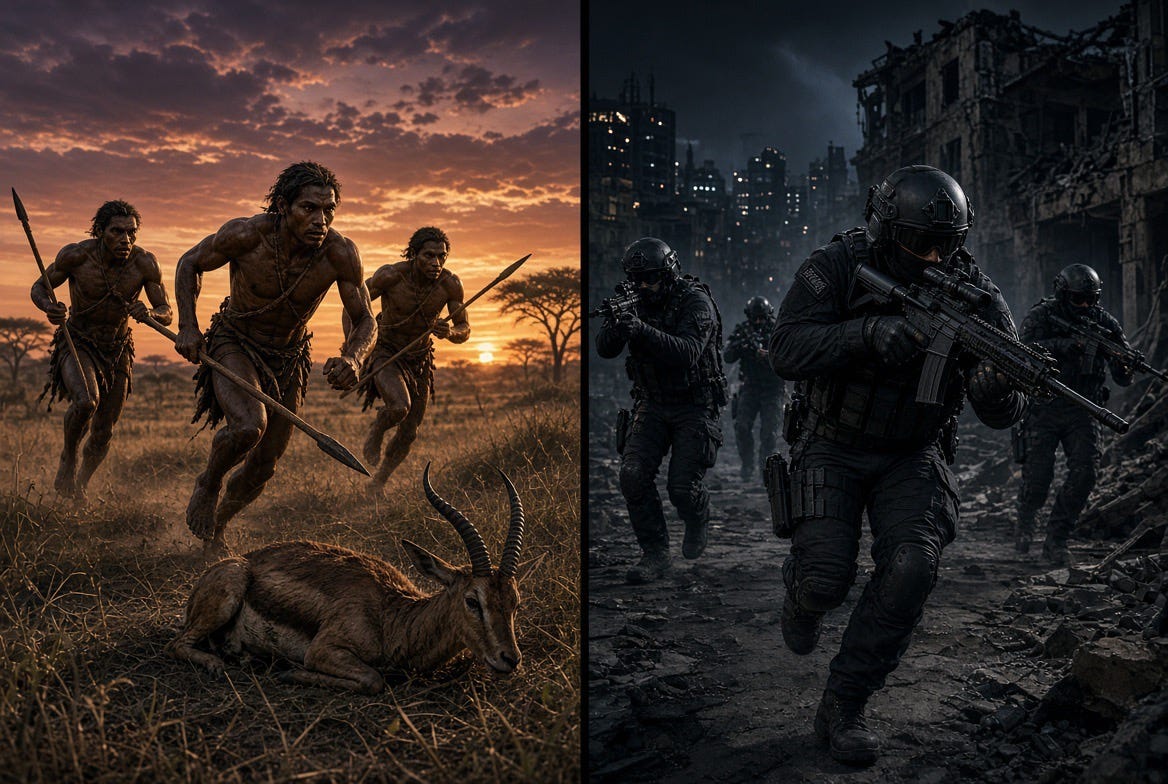
Other animals survive because their bodies fit a particular environment. Humans increasingly survive because we can make the environment fit us. Other apes survived by refining their physical fit to a specific forest canopy. Our lineage survived by becoming less dependent on anatomical specialization to any single environment.
Cold climate- no fur required, make clothing. Hard food- no crushing jaw required, make a tool. A predator stronger than you- don’t get stronger, recruit six friends. Prey faster than you- don’t get faster, track it, coordinate, exhaust it. Night is dangerous- build a fire. As it seems our bodies are uniquely adapted to persistence hunting, the innate desire for sodium and dense carbohydrates would inevitably lead to heath issues should the environment be adequately altered so as to eliminate the need to hunt persistently.
That flexibility also hides a second consequence inside it. If a problem can be solved behaviorally rather than biologically, different groups of the same animal can solve identical problems in completely different ways- different foods, different shelters, different customs, different rules for children, different behaviors treated as normal, forbidden, or disgusting. At first these are simply different learned solutions carried by different groups. Eventually, they can become sources of friction between differing societies.
Something more peculiar happens. Humans begin treating the behavioral environment that shaped them as a standard for judging other humans. The hairless ape stops learning only this is how we do things and starts learning this is how proper people do things. From there it is only a short conceptual distance to this is how civilized people do things.
Adaptation escapes the genome
Genetic adaptation is powerful, but it’s also incredibly slow. A beneficial variant has to arise, survive, reproduce, and spread across a population one generation at a time. Learned adaptation moves sideways instead. One person discovers something, another watches, a third modifies it, and a child inherits the improved version without ever encountering the problem that produced it in the first place.
This is cumulative culture, and it means information can be inherited without ever touching a genome. Humans can now receive adaptations that nobody currently alive invented. The bow maker doesn’t need to invent bows. The fire keeper doesn’t need to discover fire. The child learning which mushrooms are lethal doesn’t need to find out by dying.
For the first time in this story, adaptation can outrun reproduction.
Every human now develops inside two overlapping environments at once. The first is the physical world- climate, terrain, predators, prey, plants, water, seasons. The second is the cultural world other humans have already developed within the physical one- tools, fire, paths, shelters, hunting strategies, kinship structures, expectations, gestures, stories, taboos, names.
A child never actually meets “nature” in some pristine, uninterpreted state. The child meets a world that earlier humans have already touched, and the loop that follows is recursive: humans adapt to the environment, humans alter the environment, later humans adapt to the altered environment.
That recursion runs deep.
We still carry the metabolic and neurological impacts of the very environment which initially distinguished our bodies from the hairy tree apes. The compulsive drive for sodium, dense calories, and quick carbohydrates is not a design flaw; it was a survival imperative on a plain where dense energy was rare and acquiring any sustenance was a sweaty affair.
We carry that same metabolic engine into a world of engineered abundance, just as we carry an instinct to monitor social standing and group consensus. In a small foraging band, social exclusion was a physical death sentence; today, that same ancient alarm sounds over an unreturned message or an abstract political rift. The body is still living on the savanna; the mind is navigating a world built by its own descendants…
Where they don’t even ask anymore if you’d like fries with that.
It’s just assumed you would.

The animal that can copy another mind
What makes human language extraordinary is not communication itself but the transmission of absent information- one human changing another human’s behavior using something that isn’t currently present at all.
Water beyond that hill. The herd passed yesterday. Don’t eat that plant. Your grandfather did this. Meet me there tomorrow. Something killed a man near the river last winter.
Once language carries enough expressive power, experience becomes partially transferable. A person can learn from an event they never witnessed, which means an individual’s adaptive experience no longer has to start from zero at birth. Each new human can arrive with pieces of someone else’s experience already installed before they have done anything to earn them.
An individual may die, but some portion of what they learned does not have to die with them. It may not be their whole consciousness, and the result may not be anything close to literal immortality, but it can be something real enough to cross the boundary of a single lifespan. The dead cannot speak, but the living can still remember what they said, and they can say it again to the next generation.
The limits of the living archive
Oral culture is a living memory system. Societies preserve enormous bodies of knowledge through repetition, ritual, formula, performance, specialists, genealogy, song, and collective correction- a real archive, doing real work.
The problem is that the storage medium is still a human being, and that fact imposes hard constraints. Information has to be learned. Someone has to retain it. Someone has to transmit it. Recipients have to reconstruct it. The chain has to stay unbroken, and every single thing worth remembering is competing for space against everything else a person must also carry.
Leadership, authority, and law remain mostly bound by presence and proximity. A leader’s command reaches only as far as a voice can carry, and a culture’s wisdom lasts only as long as an elder’s memory holds.
Culture, at this point, has escaped the genome, but has not yet escaped the human being. No cities exist yet. No bureaucracies, no writing, no kings required, no theological canon…
And yet the important transformation is already fully underway, because the human ecological niche now includes other humans and everything they’ve already made.
A child is born into knowledge accumulated before they existed.
That knowledge changes what they can do.
What they do changes the environment the next generation inherits.
Culture is more than something humans simply possess- it is part of the environment humans themselves are shaped by…
Recursively…
As we inherit the civilization those hairless apes who refused to grow up built for us.
This is the first essay in a series of 5:
The Apes That Never Grew Up
The Narrative Structures
When Memory Left the Brain
A God Among Gods Becomes God
The Text Inherits the People