The Object Hasn’t Arrived


Transmissions In Overdrive
Freedom is important.
“Freedom is important.”
Two people say it.
Both agree.
Or do they?
One means freedom from: the right not to be forced to do something against your will, especially through coercion by another person or institution.
The other means freedom to: the right to do what you choose, without another person or institution preventing you from doing it.
Both received the sentence perfectly. Nothing was lost between the speaking and the hearing. The words arrived intact, and each person can repeat them back without error. Yet neither person has actually agreed with the other. The shared word creates an illusion that a shared object sits on the table between them.
It doesn’t.
Two different constructions of freedom are sitting where one appeared to be, and until that gets sorted out, neither person actually knows whether they agree or disagree with the other.
The symbol has arrived.
The object hasn’t.
Expression Is Not Arrival
An idea can’t move directly from one mind into another (yet). It has to be represented externally first- put into words, images, gestures, examples, metaphor, mathematics- whatever the speaker has available. The listener receives a representation, not the idea itself, and builds something out of it using their own experience, memory, associations, and existing concepts- a reconstruction.
Three different things are at work here, and collapsing them into one is where most communication goes wrong:
Objective reality is whatever actually exists or happened, independent of anyone’s interpretation of it.
Representations are the words or symbols exchanged between two people trying to describe or discuss the object.
Reconstructions are the meanings each listener privately builds from the representations received.
The Universe Inside Your Head explains how and why every mind constructs its own internal model of reality rather than perceiving it directly, but for now all we need is the consequence: since two minds never share direct access to each other’s internal models, they can only ever exchange representations and hope the reconstruction on the other end is close enough.
That’s the actual work being described when two people “communicate.”
Communication isn’t just transmission.
It’s translation.
Transmission moves a representation from one mind to another. Translation is the separate, harder task of making the structure inside one subjective model intelligible inside a different one. A perfect transmission- the words and symbols arrived exactly as sent, nothing garbled, nothing dropped- guarantees nothing about whether translation actually happened. The meanings of the symbols in the receiving mind must be, at least, compatible with those of the sending mind.
Successful communication can’t be assumed just because the language was understood.
The Illusion of Understanding
Two failures follow directly from that gap, and they run in opposite directions.
False agreement happens when two people use the same representation while building different meanings from it, and mistake the matching language for a matching object. This costs more than an ordinary misunderstanding, because I t manufactures false corroboration- one person now believes their interpretation of something has been independently confirmed by another mind, when no such confirmation ever took place. The freedom example from the opening is exactly this: two constructions, one word, and an illusion of agreement neither person actually verified.
False disagreement happens when two people use different representations while pointing at substantially the same thing, and mistake the difference in language for a difference in meaning. Two people can describe the same pattern in incompatible-sounding vocabulary and end up arguing about the words instead of comparing what they actually observed. What should have been two compatible pieces of information getting combined turns into a semantic argument.

Real disagreement is what’s left once both people have actually understood each other and still land in different places. This is the disagreement worth having, because at that point the two positions have actually been established well enough to evaluate against each other.
Same words don’t guarantee the same meaning.
Different words don’t guarantee different meanings.
The only question that actually settles anything is whether both people are pointing at the same thing.
If verification matters this much, why doesn’t it happen constantly?
Transmission Is Cheap
Translation costs time and effort, and most conversation would grind to a halt if every sentence needed full reconstruction and verification before anyone was allowed to respond. The engine driving the typical transmission runs on shortcuts instead- shared language, convention, context, familiarity, reasonable assumption. Usually that works fine. Efficiency is doing real work here, not getting in the way of something better.
The trouble sets in when the shortcut gets mistaken for a confirmation. Recognizing the symbols gets confused with recognizing the intended meaning, especially once information is moving fast enough that there’s no time to check. Modern communication has increased the speed and volume of transmission by an enormous margin without doing anything comparable for the fidelity of translation. Social pressure, identity, ideology, and tribal affiliation all make the gap worse- a category can substitute for genuine reconstruction the instant a sentence gets recognized as belonging to the kind of thing people like that say.
Nobody needs to verify everything they hear. What’s missing is a reliable way to notice when understanding actually matters enough to check.
“Is This What You Mean?”
The fix is modest. When the meaning matters, translate before evaluating. Translation isn’t repeating someone’s words back to them. It’s reconstructing what they appear to be saying in different terms and letting them either recognize the reconstruction or correct it.
“People need consequences for their actions.”
“So you’re saying people should be punished when they do something wrong?”
“No. Punishment is one possible consequence. I’m talking about keeping the result of an action connected to the person who did it, so the consequence stays available as feedback.”
“So the pain isn’t the point. The point is that what happened stays legible to the person who caused it?”
“Yes. That’s what I mean.”
Only now does agreement or disagreement have a verified object to work with. Compressed, the movement looks like: expression, translation, verification, evaluation. That isn’t a rigid protocol meant for every exchange- it’s the operation that’s missing whenever a misunderstanding actually matters.
Translation doesn’t require agreement, and it shouldn’t get confused with politeness, compromise, charity, or avoiding conflict. Sometimes it reveals agreement that was hiding under different language. Sometimes it reveals a real disagreement that was there all along. Sometimes it establishes plainly that someone is wrong. Its job isn’t to produce a particular outcome; its job is to make sure both people know what outcome they’re actually looking at.
That matters for more than avoiding arguments, because it affects what two people can actually come to know together.
Comparing Notes
Human beings experience an objective reality (I assume) and experience all of it from a subjective position. Nobody has complete access to what’s actually there. Each person receives a limited slice of sensory information and runs it through an internal model to make sense of it.
Communication is what lets separate observers make pieces of their private observations available to each other. Stripped down to its most basic epistemic function, communication is comparing notes: what did I see, what did you see, what do we each think it means, where do our accounts corroborate each other, where do they conflict, and what interpretation actually accounts for everything both of us can establish.
That is exactly how we derive empirical knowledge.
None of that eliminates subjectivity or hands anyone direct access to objective reality. Rather, it lets separate subjective positions constrain each other, correct each other, and occasionally corroborate each other in ways that neither position could manage alone.
This is where the earlier distinctions stop being a communication tip and start mattering epistemically. False agreement manufactures corroboration that was never actually earned. False disagreement hides corroboration that was sitting there the whole time, buried under mismatched language. Real disagreement is the one case that actually points to something worth investigating further- a genuine gap in observation, evidence, or interpretation that neither person can resolve just by talking past it.
Winning the argument is never the ideal goal. At its best, communication lets two incomplete, subjective modelscombine into something closer to accurate than either one could reach alone.
Transmissions in Overdrive
What did transmissions mean, back when it was still just a subtitle to this essay?
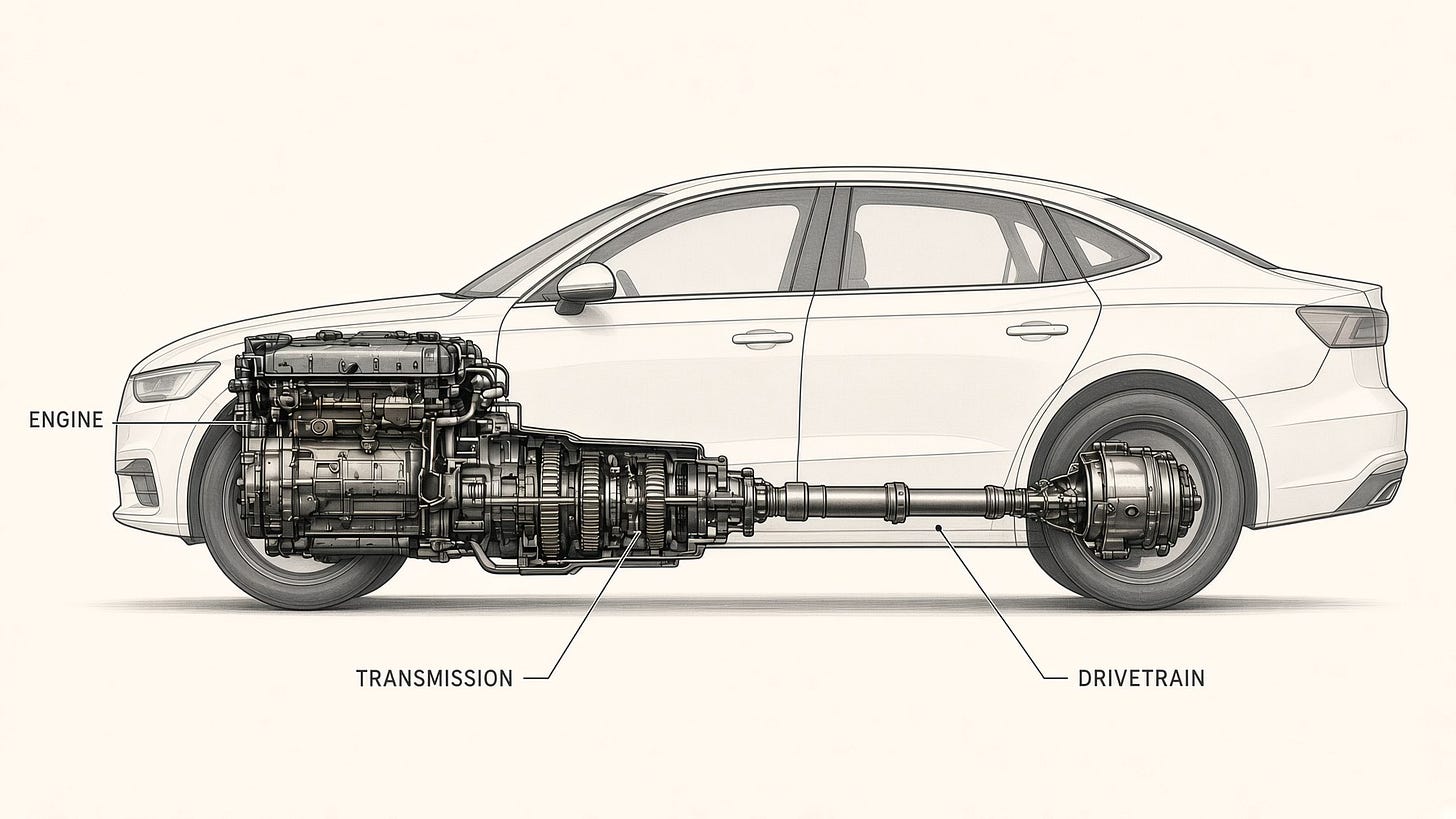
A transmission can be a signal sent from one place to another, as it would appear the subtitle meant, but it can also be the mechanism that carries power from a vehicle’s engine to its drive train. Overdrive can mean operating at an unusually high rate or intensity, or it can also just mean the actual gear on the transmission.
The words arrived perfectly, long before the essay explained anything. Nothing about receiving them told you which meaning was intended. That’s the entire argument, sitting in five words above the title before a single sentence of the essay had been read.
The transmission succeeded.
Translation was still required.
Humanity is running its transmissions in overdrive- more representations, moving between more minds, at greater speed and volume than at any point before this. None of that capacity for transmission does anything on its own to produce greater understanding. A signal can arrive at full strength while the object it was meant to carry never shows up at all.
Before agreement or disagreement can mean anything, there’s a prior question worth asking: what is the other person actually pointing toward? Share what you observed. Translate it. Compare notes. Correct the reconstruction when it needs correcting.
Transmission moves the symbols.
Translation is the process where two separate, subjective worlds find out what they’re actually looking at…
Together.