True To Our Roots

Our Common Ground: Earth
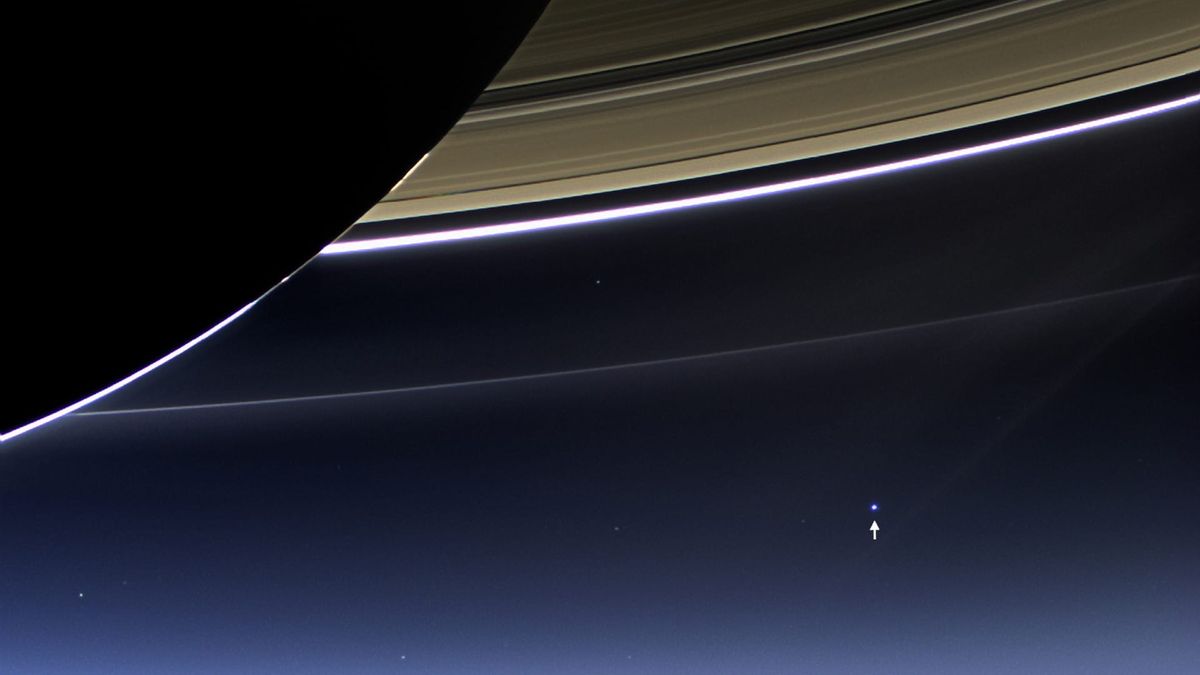
From six billion kilometers, Voyager 1 photographed Earth as a pixel- a pale blue dot suspended in a sunbeam, barely visible against the cosmic dark. Every human who ever lived, every war fought, every doctrine written, every love declared: all of it occurred on that mote of dust. Carl Sagan saw it clearly: there is no hint that help will come from elsewhere to save us from ourselves. For now, this world is where we make our stand.
- Doctrine of Lucifer | Chapter 10
Ask a fish how the water is, and the fish may answer: What's water? We are that fish. We breathe air on a planet so constant we mistake it for background. Multiplication, conquest, industry—each wave we dealt landed and the world absorbed it. Every swing toward the extreme has always returned to equilibrium. This continuity hardened our expectations into certainty: context will hold because it always has.
It won't.
The cosmos does not offer us a second Eden on demand. There is no ark, no cosmic insurance policy waiting beyond the sky. The Rare Earth Hypothesis proposes that the conditions required for complex life may be far less common than the abundance of planets would suggest. Whether that hypothesis ultimately proves correct remains an open scientific question. For our purposes, the distinction is immaterial. Earth is the only planet known to sustain the intricate biological systems upon which human civilization depends. We have found other worlds, but we have not found another home.
Consider the circumstances that make this one possible. We orbit a relatively stable star at a distance where liquid water can persist across much of the surface. Earth's magnetic field helps protect its atmosphere and surface from charged particles carried by the solar wind. Its oceans distribute heat, its atmosphere moderates temperature, and its geological and biological cycles regulate conditions across timescales far exceeding any human institution. The Moon influences tides and contributes to the long-term behavior of Earth's axial tilt. Even the architecture of our solar system has helped shape the environment in which life developed, although the influence of giant planets such as Jupiter and Saturn is more complicated than the familiar story of benevolent planetary shields.
None of these conditions operates alone. They interact, reinforce, and sometimes disrupt one another. We inhabit the outcome of billions of years of accumulated relationships, and our survival depends on systems we did not design and cannot presently reproduce.
Stack the filters- star type, magnetic shield, tectonic engine, lunar influence, planetary neighbors, galactic address- and the romance of endless interchangeable worlds begins to dissolve. The universe may contain other Earths. We have no reason to assume that any are available to us.
Earth is not generic.
Earth is specified.
Earth formed us. That fact alone is enough.
Yet the new myth pretends otherwise. Mars is sold as frontier, but too often it is packaged as salvation. The dream of terraforming another planet becomes the old theology of escape repackaged with rockets and jargon. Salvation by propulsion. Heaven rebranded in dust. Exploration is one thing. Treating a hostile world as an alternative to maintaining the only habitable one we possess is something else entirely.
Mars offers extraordinary opportunities for scientific discovery, but its surface is profoundly hostile to human life. Its atmosphere is too thin to breathe and provides little protection from radiation. Its lack of a global magnetic field leaves the surface exposed to conditions that would require extensive shielding. Temperatures vary enormously, liquid water is unstable at the surface under ordinary conditions, and perchlorates complicate the use of Martian soil. Any settlement would require carefully maintained systems for pressure, oxygen, water, temperature regulation, food production, and waste processing.
They are not backing up the house. They are adding a loft.
The nature of Mars makes that loft rather expensive to keep habitable… What we receive here as an ordinary breath would entirely depend there on equipment, power, and somebody remembering the inspection.
A settlement dependent on machinery, imported resources, and continuous technical maintenance is not an independent replacement for Earth's biosphere. It is another environment requiring human stewardship, only with considerably less room for error. Even a technologically sophisticated Martian civilization would have to solve many of the same problems of governance, resource allocation, ecological balance, and institutional continuity that confront us here.
The promise of a backup planet therefore deserves scrutiny. A backup should preserve the essential functions of what it replaces. Mars cannot presently do that. It may eventually support human settlements, but a settlement is not a biosphere, and expanding the places humans can survive does not automatically secure the continuity of the civilization that sent them.
The question is not whether humanity should explore Mars. The question is whether the possibility of living elsewhere excuses our failure to maintain the conditions that sustain us here.
The Doctrine refuses that delusion. Redemption is not exodus—it is repair. We have already terraformed Earth once, by accident and arrogance. Rivers straightened. Wetlands paved. Forests shaved into parking lots. The feedback loops that kept climate, water, and life within habitable ranges were interrupted first for speed, then for style. We transformed landscapes to serve immediate demands and treated the consequences as problems for someone else to inherit.
The only question left is whether we will terraform Earth again— this time on purpose.
Restoring damaged systems on Earth is a different undertaking from creating a habitable environment on Mars. Earth already carries the assets every off-world settlement must labor to reproduce: liquid water, breathable air, living soil, oceans that move heat, winds that move seed, and biological communities capable of regenerating when the conditions permit. These systems are neither indestructible nor infinitely forgiving, but they exist. We do not have to invent them from nothing.
The work is here. Put loops back where we cut lines. Daylight buried creeks. Add detention basins and bioswales. Seed cover crops and plant windbreaks. Restore wetlands where floodwaters once had room to spread. Retrofit buildings to breathe with seasons instead of fighting them. Reconsider the pavement, drainage, and development patterns that turn ordinary rainfall into recurring disaster. Measure what degrades and restore faster than you extract.
This is not an argument for abandoning technology. It is an argument for directing technology toward the maintenance of the systems upon which its continued usefulness depends. A civilization capable of sending machinery across interplanetary distances ought to be capable of examining why its own watersheds are failing. The engineering challenge is not beneath us simply because it lacks the glamour of a rocket launch. The consequences are no less substantial.
Nor is restoration a matter of returning the planet to some imagined pristine condition. Human beings are already participants in Earth's ecological systems, and our activities have altered them in ways that cannot simply be reversed. Maintenance requires recognizing those changes, understanding their consequences, and making deliberate corrections. Some systems can be restored. Others must be redesigned. Still others require us to stop interfering long enough for their own processes to recover.
The point is not to preserve everything exactly as it was. It is to preserve the conditions through which life can continue adapting.
This is not romance. This is specification. The material foundations of human meaning are found in topsoil depth, watershed clarity, pollinator corridors, and seasonal rhythms understood rather than overridden. Our philosophies, economies, governments, and technologies operate within these conditions, not above them. Destroying those foundations does not merely threaten individual lives. It threatens the continuity of everything we have built upon them.
This is the subject of 🌍 Chapter 10 — Grounding the Flame in Terra-Centric Maintenance, in The Doctrine of Lucifer. The chapter examines our dependence on the conditions Earth provides, the promise of escaping those obligations through colonization of Mars, and the practical work of maintaining the world we already inhabit. Its central proposition is straightforward: human continuity requires more than preserving civilization's institutions. It requires preserving the conditions that make civilization possible.
The frontier is already beneath our feet. Learn to live here.